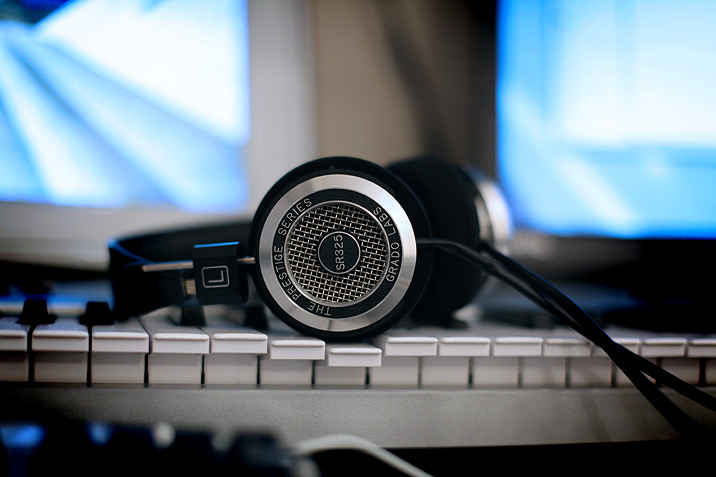
About a year ago, Jim lent me his Grado headphones for a week. I spent that time listening to the difference between what I was getting from my existing headphones and what I was getting from the Grados. Though the difference was significant, I wasn’t sure if they were the right headphones for me, as I wouldn’t be able to use them for DJing at gigs and such.
About a week ago, I went to Soundhounds and tried some Grado headphones. I settled on the Grado SR325i’s. As the image suggests, my needs for headphones has shifted from DJing to studio use. I have not been using headphones for producing because that’s generally a bad idea, mostly due to the forced dynamics and pressure of closed-air headphones.
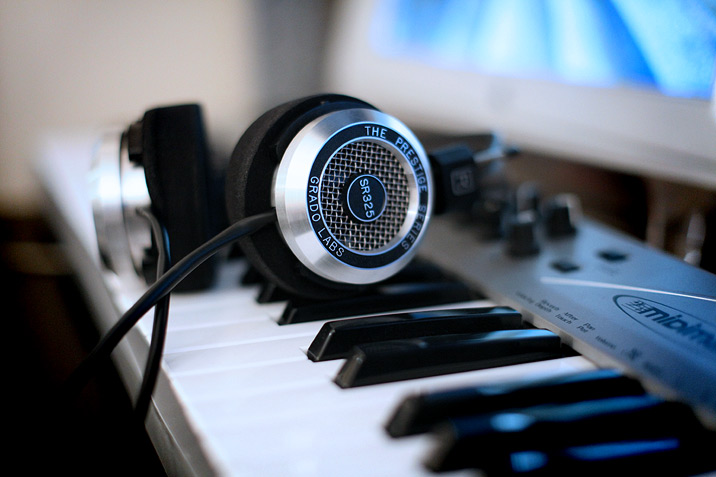
The Grado SR325i is an open-air pair of headphones. To the outside observer, it must sound like it is deafining me when I am wearing them, but in fact it’s a trick since they’re open air and a lot of sound escapes instead of being trapped between the headphone and my ear. The flipside of this is that they can not be noise canceling. Hence they can not be used for crazy DJ gigs where the monitors have to be super loud and the headphones even louder. They spend most of their time sitting on my M-Audio Radium 61, and then some time on my head where I listen to music.
The thing I noticed most about these headphones is how effortlessly and fully they reproduce sound and frequency while scaling up and down in volume. Many headphones have a threshold of performance where the high or low will sound alright at mid volume, but then you turn up the volume and the high or low starts getting muddy or actually distorted. With the SR325i’s, it’s as if they’re not even trying – which is dangerous, since it is really easy to turn up the volume too much since it never sounds bad.
What did I have to compare them to?
My previous pair of headphones were Sony MDRV-700s and, as powerful as they were and good as they looked, they were flimsy. The MDRV-700s broke a lot and were expensive to repair; eventually I zap-strapped the hinges just to keep all the pieces together. I knew many others who had these headphones and eventually they all did the same thing. Pathetic, Sony, pathetic. Finally, the MDRV-700s would distort at higher volumes and I have no idea what the EQ on it was but it couldn’t have been anywhere close to flat. I could hear reasonably well, but sometimes I would wonder if I was hearing distortion because I had put something through a distortion unit or if it was just coming from the headphones.
The SR325i headphones feature a very flat EQ, which makes them ideal as reference monitor headphones for producing. There are no false spikes (or boosts) in frequencies, so it’s very reliable in terms of what you’re actually listening to. It’s like having a ColorSync’d monitor for design work – much better for picking colours. These are much better for picking sounds and sculpting them.
All in all, I am very happy with these headphones and look forward to composing and producing a lot of music with them.


Leave a Reply
You must be logged in to post a comment.