


life in transit
Category: photography
-
victoria sunrise

This is a view of this morning’s sunrise over Craigdarroch Castle. Shot from my living room at 7:53 AM.Matt pointed me to a radio station he has been listening to – Monkey Radio. The website might not look like much, but that’s fine, because the music programming is the best downtempo / chill I have ever heard on a station. Monkey Radio might even be better than the trusty Groove Salad. Recommended, and thanks to BoS for the link.
-
the ultimate treehouse

This fall past, I was taken up-island for a surprise. We drove into the area of Qualicum Beach and entered a mysterious grove with a log cabin and a forest behind it. I guessed that we were zip-lining or something to that effect, but I was totally wrong! (I do like to guess though.)We stayed in one of these spheres, made by Free Spirit Spheres, for two very relaxing nights. The spheres were connected to the ground by a spiral staircase and small suspension bridge, and the sphere itself is hung from 3 trees. When the wind blew the trees around, the sphere would sway gently in the wind.
It was a three day stay in the ultimate treehouse.
“The ‘Spherical Tree House’ concept borrows heavily from sailboat construction and rigging practice. It’s a marriage of tree house and sailboat technology. Wooden spheres are built much like a cedar strip canoe or kayak. Suspension points are similar to the chain plate attachments on a sailboat. Stairways hang from a tree much like a sailboat shroud hangs from the mast.” – Tom, Free Spirit Spheres
Our hosts, Rosey and Tom, were gracious and kind. They even invited us up to the cabin if it got too windy for our liking. It never did, or perhaps we liked the wind. In addition to being a great host, Tom also makes these spheres himself. Here is Tom, hanging out in the shop where he makes the spheres:

In the day time, we explored Qualicum Beach and also the nearby Horne Lake Caves. I had never been spelunking before, and even though we went on a 90 minute tour of one, it felt like it was over just as it began. Caves are deeply fascinating places to spend an afternoon – next time I’d like to go for the 3 hour tour. Apparently there are well over 1500 known caves on Vancouver Island. I did not know that until I went to Horne Lake. Back to the spheres. . .
“In bio-mimicry fashion, the nut like shape attaches to a web of rope. The web connects to which ever strong points are available. This replaces the foundation of a conventional building. A tree house sphere uses the forest for its foundation. The occupants have a vested interest in the health of the grove. The supporting web also mirrors our connectedness to our eco-system. Each sphere has four attachments on top and another four anchor points on the boom. Each attachment is strong enough to carry the entire sphere and contents.” – Tom
I am already trying to figure out when we can go back to go live a few more days in the sphere. Not only is it relaxing and cool, it is also a local business that is centered around being in harmony with the environment. If you ever get a chance to go stay in one of these spheres, I highly recommend taking the opportunity.
-
defining the value of design

The entrepreneur who picks a logo off the shelf to use, solely because it appeals to himself or herself, is more likely to fail in business than the entrepreneur that engages in a full design process. This isn’t just because self-reflection can sometimes be a smokey mirror. A full design process can be defined many ways, but for this post, lets say it is is one with research, symmetrical communication between the organization and its stakeholders, and sound design thinking with evaluation. Designers know the value of the design – but how can this value be articulated and understood by those outside of the industry? How do you define the value of design?
Business is based upon a trade of value – or an exchange. The fundamental concept behind it is that we, as a society, are better off if one specializes individually and then provides the expertise of specialization to others in exchange for money or barter. This relationship is built on trust, and – I imagine, in the old days, much of trust was based on and delivered by face to face meetings in a market or private store of some sort. Without that trust, you could not be certain that you would get what you paid for; the exchange may not have value in that case. We will be having a guest post from Matthew Politano (Oculus Design + Marketing) on the subject of design and trust which will elaborate much more on this subject.
Business has grown far beyond the original model of exchange into a global system of giving and receiving between people that may never meet or even speak. A gap has grown between those who make or provide, and those who consume or participate.
In this gap, intention, character, relevance, value, and relationships themselves become elusive. How do consumers connect and level with the merchants that they need to? Who – or more accurately – what is speaking to consumers in an age where so much business is done, literally, in seconds across the entire world? The subject of design, amongst other business practices, speaks volumes as to how organizations establish themselves, connect with their intended audience, and maintain a relationship. Indeed, design has elevated to the limelight of worldwide attention by becoming the hands and face of the modern business. In this sense, it appears to be a pretty remarkable noun. But what else is there to it – why can’t an entrepreneur buy a logo off the shelf and expect to have consistent and reliable success with it?
Design is much more than a noun; design is first and foremost a verb which has parallels in other fundamental business concepts."Design of logos involves effective articulation and visualisation of communication concepts determined by the client’s individual marketing goals. It involves analysing, problem-solving, strategizing, structuring, planning and creating images and text for specific purposes, including differentiating the client in the marketplace. Design affects a client’s bottom line, motivates potential customers, captivates audiences, cultivates brand recognition, and influences public perception of the company, service or product." – Peggy Cady, FGDC
Traditional business has market research; modern design is based on listening to the business and the market simultaneously. Traditional business has a marketing plan; modern design has an agile and maneuverable creative brief which outlines how the business speaks the language of the intended audience. The list could go on. The long and the short of it is that design has adopted the most critical processes from traditional business practice and utilized these processes into smart, two-way, relevant practices for the visual communications environment of today.
A gap exists between a company or organization and its audience. Thisall-important gap is the space in which an organization can sink or swim. The organization can put their communications into it – visual and otherwise – and if it’s hit the mark, it will reach the other end where the intended audience is. If it’s the first time this gap has been explored, however, the chances of making the connection is slim. Why? Because they haven’t figured out who is on the other side of it, and what will make them hold on to something that is making its way across. Indeed, exploration of the gap is very important. The gap between an organization and their intended audience is where the creativity can truly happen.
Traditional communication sees an organization position itself (or a brand that it owns) inside this gap. Broadcasting occurs asymmetrically – that is to say, the message enter from the organizations end and then are received en-masse. The theory roughly goes "if you communicate enough where you think your audience *should* be, then things will go according to plan." The image and words can be extremely calculated to reach as many as possible. It ends up notably impersonal and ambiguous as a result. Unfortunately, that vagueness is exactly where the relationship between organizations and intended audiences breaks down."Graphic design ignites passion, identifies, informs, clarifies, inspires and communicates in our interconnected, interdependent, real-time world. Identity has to do with what lies within and with intrinsic qualities – if that’s the case, are we satisfied with the qualities and values of graphic design as a profession? Never has there been a greater need for designers to dig deep, to exercise whole-brain thinking skills, to understand patterns of inter-connectivity, to join peer networks, to collaborate with other experts and to leverage the multi-perspective advantages of teamwork. How to best proceed, and to succeed? Help break down divisive barriers, embrace pluralism, raise the bar for civilization – and above all, further the characteristics that matter in making us truly human beings." –Robert L. Peters, FGDC, "Worldwide Identity" (Rockport Publishers)
Indeed, design requires understanding and a significant deal of whole-brain thinking to turn ideas, space and relationships into a meaningful catalyst for interaction. Nobody said design was easy – but does it need to be a shot in the dark? Absolutely not.
Symmetrical communication and thinking throughout a design process ensures that those who need to be spoken with are identified and understood. Market research and analysis uncovers who the stakeholders are and engages them. The relationship It is built on understanding and relevance, not volume and inundation. There is no need for excess when the mark is being hit. There is as much focus on who the organization is as who their audience is. The relationships are the priority.
Exploring the gap with symmetrical communication between the intended audience and design itself allows an intimacy which allows the merchant to be human again. A complete design process is one that not only enables a business to articulate itself, but one that also gives businesses the profound ability to listen. This is one of the many values that design brings to modern business.
None of this is to say that there is a problem with an organization deciding that it must, on its own, determine how it wants itself to be perceived, or its products – on the contrary, those organizations with a raison de’être will understand very well who their audience is, and may even be born of it. The business process required is one of critical thinking of the opportunity in front of them, and an action to address what they find. In other words, the business process has come face to face with the process of strategic intent: design.
I am not going to pretend this is an easy subject, or that it is even well-understood, especially by those who need to understand it – as Mark Busse points out on the Industrial Design blog.
There is an entire conference about the value of design coming up in Vancouver put on by Icograda and hosted by the GDC. It is Icograda’s world-touring design week, and next April it is in Vancouver for Design Currency – Defining the Value of Design. As an aside, I had a fantastic time putting the Design Week site together with Steve Fisher and Matthew Warburton. I had actually started this post in September and had no idea that there would be a conference about the value of design, so I think that goes to show the mindshare of the subject amongst those who think about a design a fair bit. The thought of mobilizing on a subject of this size is truly invigorating. If you have read this far, go look at the Design Week Vancouver website here:
www.designweekvancouver.ca
See the headphone jacks at the beginning of the post? They look similar but they’re not the same. I’ll buy a drink for the first person to identify what the difference is – and what the implications could be for anything that could possibly follow that one, simple, difference.
I invite you to share your thoughts in the comments area below. How do you define the value of design?
—
This was originally posted earlier tonight on www.gdc.net. -
be leaf in transformation

Short little story.
Several years ago I made some non-refundable travel plans, picked up some photo equipment, and found myself laid off twice in a row by two different companies. Bad luck followed by more bad luck. Debt that was going to be paid off was .. not so quickly paid off. Instead it was put on hold. However, some companies like HSBC saw it to be a fit opportunity to turn my retail account (do not pay for 3 months kind of deal) with London Drugs (that I started for my camera purchase, one I don’t regret) into a payment plan. Having little other options and already paying off another loan, I took the opportunity to spread out the payments that I could while underemployed. This worked, but HSBC slapped 29.9% interest on the account because they could see that I didn’t have many options. After some time, I realized I need to pay this off first, so credit card debt started to build up instead. 19% interest isn’t as pressing as 29.9% interest. I switched my credit card to be 11% interest, and I started hammering away at the HSBC loan. At this point I had been gainfully employed again for at least half a year, and I realized all of this was unwise – I needed to consolodate my debt. I went to the banks and credit unions to help me out with a lower interest rate and a plan that made sense.
I went to my home branch of Coast Capital Savings – they wouldn’t help me out, even though I had been storing my money with them for around 28 years. CIBC wouldn’t either. Then the next bank I went to (I can’t remember now) noticed that I had been shopping around for some service (it shows up on your credit report) and also refused. So I was on my own with five figures of debt at relatively high interest. I was not particularly surprised that they refused – however, the message from Coast Capital Savings and CIBC was pretty clear: when you really need us, we don’t need you.
Later on, CIBC somehow got the idea that it would be smart to start sending me propaganda for their other, lower risk, financial instruments. It was pretty tacky. They would phone and mail. I told them to stop. It was not cool, obviously.
I set some goals for myself at that point:
1) Never get into that kind of debt again (make different decisions)
2) Remember how CIBC and Coast Capital treated me
3) Pay off the debt as my #1 priority, independently
4) Finish my degree in business, where interestingly I had done well in finance
5) Get out of debt WHILE going to school AND continuing to build my career
As of last week, #3 is done. I have with me a lesson that will help with #1 and I am making this post to help out with #2. I am well on my way with #4, and I have been lucky with #5 to actually be doing this. Work, friends and family have all been very supportive with my return to college as a mature student and I am pretty happy about that.
Of course these commitments to new goals can’t happen without paying a price of some sort. There have been some very dear-to-me casualties along the way, such as my involvement with VEMF at the management level, Justin and I have decided that Pacific Front Recordings had to cease operations as of this summer (though we’re still compiling payment info for artists obviously), and writing music itself has had to take a back seat. I’ll wrap up VEMF and PFR in their own posts as they are certainly worthy of it. Definitely my most special musical work this year has been with Vince Vaccaro and I’m looking forward to more collaborations with him.
For now I am concentrating on my career in the day time and my scholarly activities at night. What I cannot do right now is over-commit myself in the evenings or else I will not hope to have a shred of creativity for the projects I am passionate about. Make room for the things you want in your life, am I right?
Speaking of things I love, I have written and re-written a design post for www.gdc.net about 3 times over on a really broad, nebulous subject – the value of design. I have refined the idea a significant amount and it’s just about ready for prime time. I’ll cross-post it here and of course you’ll see it on the Graphic Designers of Canada home page when the time comes. -
Is this effective message placement?
First, imagine that you came across the following piece of marketing on the street. Ignore, for a moment, that you’re seeing it here.
Secondly, you are only seeing it here because I am curious about your opinion. For me, in a vacuum, it did not have enough interesting content to warrant passing on in and of itself. However, I am a marketer, and as such I am interested in your opinion on the technique being utilized.
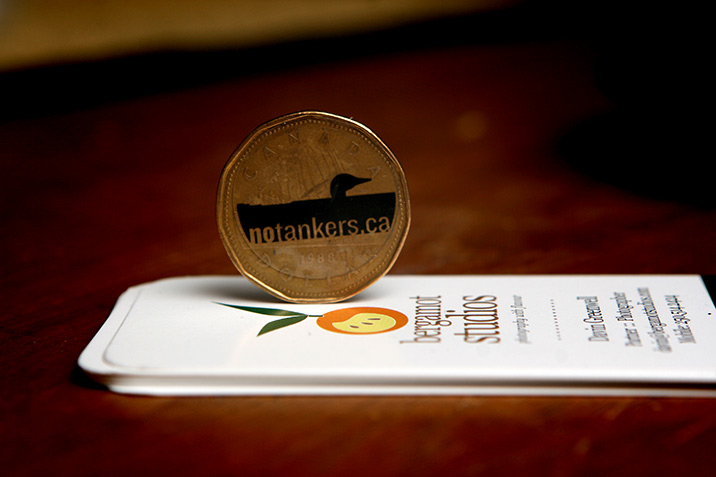
A few questions for you, the reader:- Would you go visit the URL if you found this in the change you received from a monetary interaction?
- Would you mentally retain it long enough that, by the time you were actually in front of a computer, you would remember to type it in?
- If you did remember it, would you feel compelled to actually visit the site?
- Are you at all affected by the choice by the marketers to use your money as a billboard?
- Any other thoughts?
I recognize the viral value in me posting this here, but that is not what I am interested in at the moment. I don’t think that people typically will take photos of their money. I am interested in levels of effectiveness of every-day use of advertising on change. Additionally, I am purposefully not linking to their site because, once again, that is not the point of this post.
So, what do you think of this advertising method? -
caution: not recyclable

I’ve been using shaving cream for the better part of my adult life. One might even debate that I was using it before I was an adult, and one might even win such a debate. That is not why my empty, old, and rusty can of shaving cream appears here. It’s to do with the sustainability of this packaging.
We tend to recycle as much as we can at home. In fact, it bothers me when a product is made out of metal or plastic, and is made in such a way that it doesn’t seem to be recyclable. This says to me that no consideration has been made to sustainable disposal by the name on the label – in this case, Gillette. The above fits into that category, and recently it got me thinking – there has to be a better way to package shaving cream. On this thing, the lid (not shown) is recyclable, but that appears to be all.
I am going to stop buying cans like this. I want the one I have right now to be the last of its sort inside my buying habits. Sorry this isn’t a great photo; that is not really the point of this post. The can might seem insignificant, but each night people go to sleep and 1 thing happens for sure – hair grows, which we want to then shave. This is significant enough a fact for Warren Buffett to invest in razor blades; it is also significant enough, by the same logic, for us to scrutinize the environmental packaging practices. In a world of uncertainty, it is still certain that a lot of people have shaved, are shaving as you read this, and will be shaving many times in the future. It is a fact.
Here’s a question that the men or the women can answer: what is the packaging like for the shaving cream you are using? Is there any alternative that you can suggest that does a good job of being shaving cream – one which comes in completely recyclable packaging? Is any company doing better work than their competitors in this regard? -
the technology pendulum
Is design technology doing what we need it to do? New products are everywhere, but is technology helping with quality products or obfuscating design’s purpose with quantity of products? Are those responsible for rendering our designs doing so in a timely way? Finally, is infrastructure for cloud computing ready for what designers will need it to do?
When I started designing, technology was looking for ways to catch up to design. Programs were popping up for illustration, photo manipulation, colour, pantone integration, tablets, etc. After a while, the software and hardware caught up, and (not for the first time) changed everything about the way we produced design work. Some more time goes by, the technology passed us, and the world of design moved far beyond typography, grids, shapes and the colour wheel to a lot of really technical, software and server oriented advancements. Fine, learn some code. Wait a year or two, and then no longer was simply knowing HTML enough to make websites, you had to evolve again with technology. As a designer, it was a question of not if I could learn a new programming language or program, but whether the particular language or technology was niche, or indeed the wave of the future. We, as designers, evaluate all new things this way. This, I imagine, is because we are not just designers, but also business people – people who evaluate a skill on the marketability of the skill in question. At some point you have to make a choice – either you’re going to continue learning every single program coming out, or you’re going to start doing what you love – which is to say, designing things for people that need it with the skills that you have.
For example, when Flash was new, I pondered learning it – and I did, a bit, but demand wasn’t there, and I wasn’t too interested in making animated websites that required a plugin to function. At the time, many people weren’t even allowed to install it, so it seemed like a poor idea. Over time, flash has certainly grown in appeal to me, but it’s still a niche so far as what clients actually need in terms of visual communications. Certainly it is more useful to certain types of industry than others. I digress. I love flash, it just wasn’t in demand in my area.
I don’t really want to make examples out of any specific software that I consider to be less than useful because it isn’t productive. The people who make the software know it’s not (because they see the numbers) and you know when you come across a piece of software or hardware that is not, in the foreseeable future, going to be of any use to you or anyone you know. The reasons why this irrelevant technology gets made in the first place could fill a whole blog post, so lets just say that there are reasons. The reasons themselves are not as important so much as the noise to signal when we’re looking to advance our skill-sets, and ultimately make visual communication pieces for our clients.
Lets talk about some technology that has jived with design, shall we? -
Victoria Electronic Music Festival 2009


This weekend past was the Victoria Electronic Music Festival for 2009. My involvement this year was further to my goal of being an artist and advancing my own level of performance as an artist. Part of this goal setting has seen some new synergies develop between myself and other musicians, and it was pretty exciting and pleasing to do some new collaborations with two musicians in particular – Laura Mitic (violin and vocals) and Vince Vaccaro (guitar and vocals.) We got our chance to perform what we’d been working on in front of the Ambrosia stage audience and we had a great time, despite some technical difficulties that prevented the vocal element from taking place. I’m looking forward to future shows with these two as we work really well together.
See after the break for more photos from the weekend.
